
Understanding Voltage Converters Transformers for BLUEROCK Power Tools
Posted by Todd Yamashita on 28th Apr 2026
Understanding 110/120 Volt - 220/240 Voltage Converters for BLUEROCK Power Tools
What International Customers Need to Know Before Using a U.S. Power Tool Overseas
BLUEROCK Tools products are designed for use with standard United States electrical power. Customers outside the U.S. may need a voltage converter or transformer depending on their local power system. Choosing the wrong converter can lead to poor performance, overheating, tripped breakers, damage to the tool, or safety risks.
This guide explains the basics of volts, hertz, watts, and what to look for when selecting a voltage converter for your country.
U.S. Power Specifications
Most standard BLUEROCK Tools electric tools are designed for:
- 120 Volts (120V)
- 60 Hertz (60Hz)
Some larger industrial models such as the 20Z1, 25Z1, 945vs are configured for:
- 220V–240V
- 60Hz
Always check the electrical specifications listed on the product page, motor plate, or operation manual before connecting power.
What Do Voltage, Hertz, and Watts Mean?
Voltage (V)
Voltage is the electrical pressure supplied to the tool.
Examples:
- United States, Canada, Mexico, Central America: typically 120V
- Many international countries UK, EU, Australia, New Zealand: typically 220V–240V
If your local voltage does not match the tool voltage, you may need a step-up or step-down transformer/converter.
Hertz (Hz)
Hertz refers to electrical frequency.
- United States: 60Hz
- Many other countries: 50Hz
Most BLUEROCK Tools motors can operate on 50/60Hz, but this should always be confirmed on the motor specification label and product specifications.
Important:
Most voltage converters DO NOT change frequency. They only change voltage.
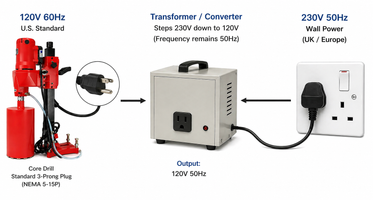
For example, a converter may reduce 230V power down to 120V for a U.S. tool, but the power may still remain at 50Hz instead of U.S. standard 60Hz.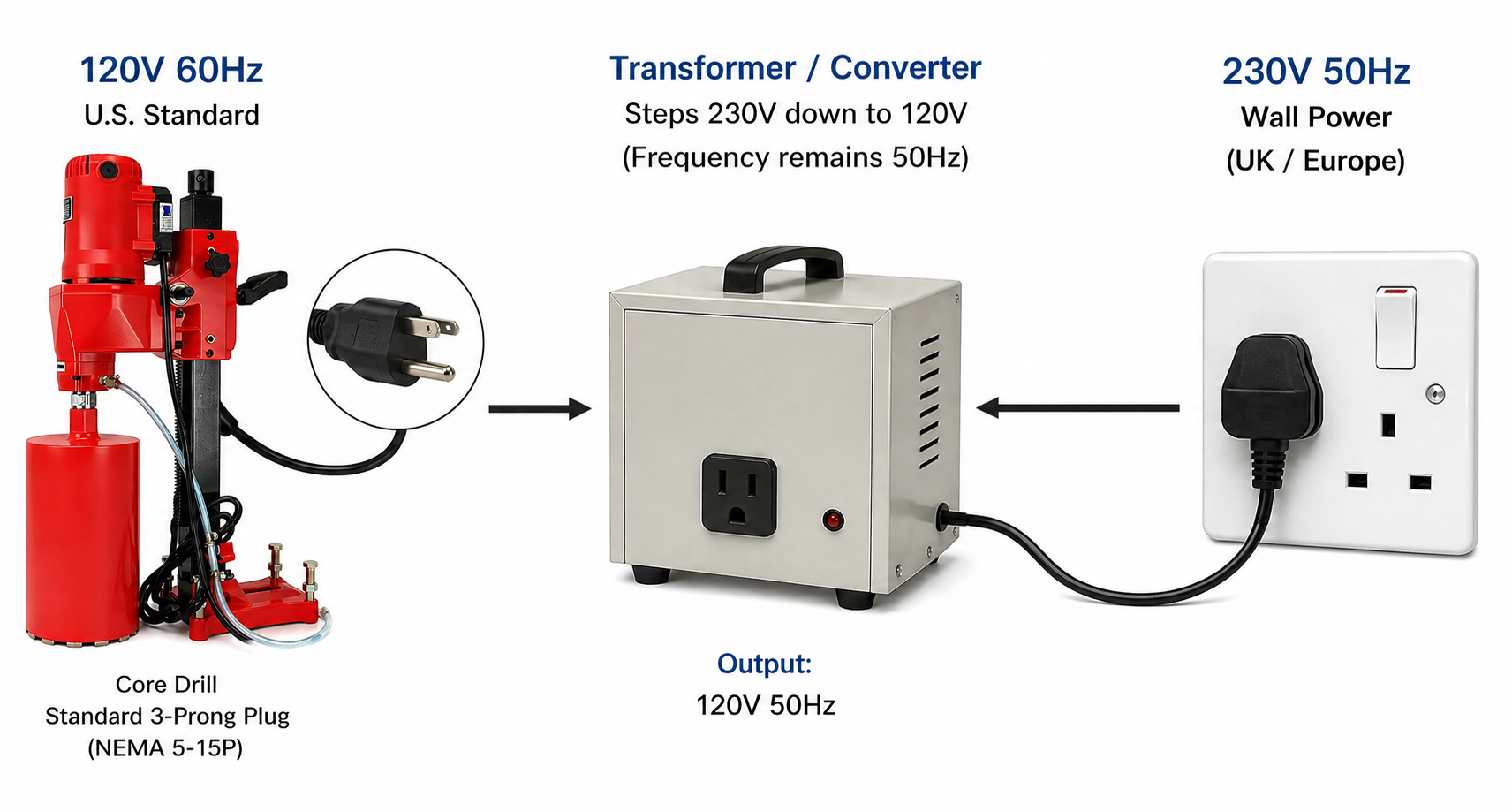
This means a 120V / 60Hz tool may still operate on 50Hz power after conversion. Depending on the tool and motor design, this can sometimes affect performance, including motor speed, power output, and heat.
Some tools tolerate this well. Others may experience:
- Reduced performance
- Additional heat
- Different RPM or motor speed
- Increased wear
Watts (W)
Watts measure power consumption.
Example:
- A tool rated at 2400W may require significantly more power during startup.
Electric motors commonly draw:
- 2–4x higher wattage briefly during startup
This is called:
- Startup surge
- Inrush current
Why Converter Size Matters
One of the most common mistakes is purchasing a voltage converter that is too small.
Example:
- A 2400W core drill connected to a 3000W converter may still overload the converter during startup.
For motor-driven tools, many electricians recommend selecting a converter with substantial overhead capacity.
As a general guideline:
- A tool rated at 2400W may require a converter capable of handling significantly higher startup loads.
This is especially important for:
- Core drills
- Pipe threading machines
- Floor grinders
- Magnetic drills
- Other heavy-load electric motors
What to Look for in a Voltage Converter
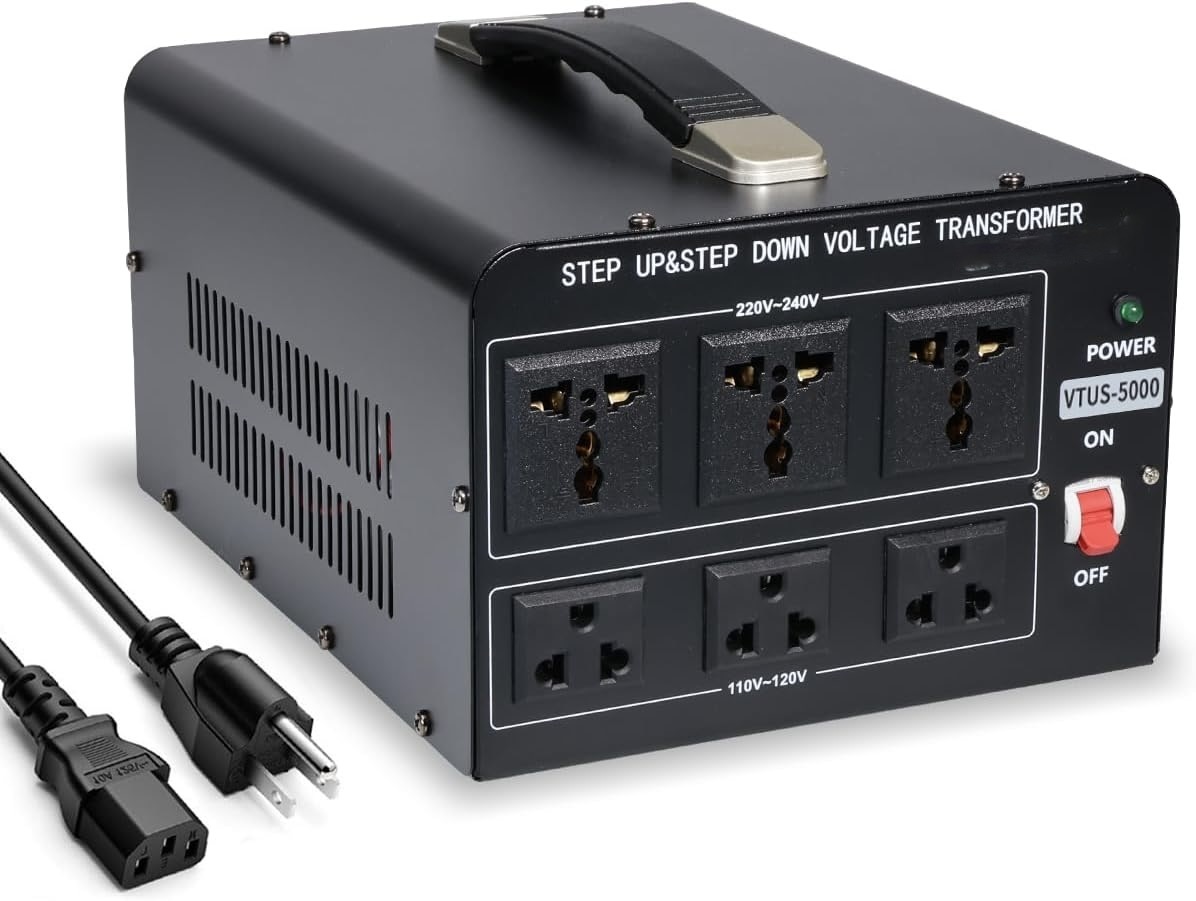
Before purchasing a converter, customers should verify:
1. Local Voltage
What power is available in your country?
- 110–120V?
- 220–240V?
2. Local Frequency
Does your country use:
- 50Hz?
- 60Hz?
3. Tool Electrical Specifications
Check:
- Voltage
- Amperage
- Wattage
- Frequency compatibility
4. Converter Continuous Power Rating
The converter should be rated appropriately for:
-
- Continuous running wattage
- Startup surge load
We generally recommend customers purchase their voltage converter or transformer locally within their own country whenever possible. This helps ensure compatibility with local wall outlets, voltage standards, plug types, and electrical regulations.
Is 208v acceptable for a 220v machine?
Usually, yes — many 220V/230V industrial machines will operate acceptably on 208V, but there are important limitations.
In commercial buildings in the U.S., “220V” outlets are often actually:
- 208V three-phase derived single-phase
instead of true: - 240V split-phase
So manufacturers commonly design equipment expecting some voltage variation.
Important Safety & Liability Notice
Electrical systems vary significantly between countries, buildings, generators, and job sites. Because of these variables, BLUEROCK Tools cannot guarantee compatibility with:
- Third-party voltage converters
- Transformers
- Generators
- Local electrical systems
- Frequency differences
Improper electrical setup may result in:
- Tool damage
- Reduced performance
- Overheating
- Fire risk
- Electrical shock
- Injury
Customers are strongly encouraged to:
- Consult a licensed electrician
- Verify local power specifications
- Properly size all electrical equipment before operation
BLUEROCK Tools is not responsible for damage caused by:
- Improper voltage
- Incorrect frequency
- Undersized converters
- Generator instability
- Improper electrical connections
Final Recommendation
If you are unsure whether a converter will work with your BLUEROCK tool:
- Check the product specifications carefully
- Consult a qualified electrician in your country
- When possible, use a properly sized industrial-grade transformer or local power source matching the tool requirements
When properly powered, BLUEROCK Tools are used successfully by customers around the world in demanding industrial applications.
If you have questions about the electrical specifications of a specific model, feel free to contact us before purchase.